LEOPRD analysed more than 200,000 AI answers across 27 brands and eight models in Australia and the UK. When AI mentioned a brand, it more often recommended a competitor. Founder Celia Harding on why the language surrounding a brand, and who else is using it, decides who gets chosen.
Donald Trump doing his best to rebrand AI as SI, or “Super Intelligence” (whether it catches on remains to be seen), offers a useful reminder for marketers that language matters.
Over the past 18 months, marketing has created an impressive number of acronyms around AI discovery. SEO. GEO. AEO. DEO and LEO. Pick your three letters.
Much of the conversation has inevitably focused on the technical mechanics: Can an AI crawler access your website? Is the content structured correctly? Are you appearing in citations? Can ChatGPT or Google AI Mode find you? All important.
But these are large language models. And marketers are paying nowhere near enough attention to the language part. Because getting into an AI answer and being the preferred answer are two very different things.
LEOPRD’s latest Reputation to Revenue Report analysed over 200,000 AI-generated responses spanning 27 brands across eight major AI models in Australia and the UK. Across unbranded category questions, the monitored brand was missing 36% of the time, mentioned but overlooked for somebody else 35% of the time, and the primary recommendation just 29% of the time.
Seven times out of ten, being known wasn’t enough to be chosen.
So while GEO can get you into an answer, it can’t manufacture a reason to choose you.
One of the more interesting findings was that brands being recommended didn’t simply have more information behind them; it was quite the opposite. Answers where the monitored brand appeared but lost to a competitor contained an average of 9.2 citations. Answers where it was the primary recommendation contained 8.4.
Meaning more citations did not equal a better result. What those sources actually said about the brand mattered more.
A company can publish hundreds of optimised pages saying it is “trusted”, “innovative”, “leading” and offers “great value”. But those are incredibly weak signals when an AI system is trying to answer a much more specific question: ‘Which one should I actually choose for this particular problem?’
Our analysis found stronger recommendation narratives tended to be specific: what the product does well, who it is particularly good for, how it is different and what evidence exists to substantiate that. Generic claims such as “trusted”, “established” and “good value” gave AI very little to work with.
‘Trusted’ is an adjective used to describe you.
‘Best suited to X because of Y’ gives AI a reason to recommend you. Which is a very different communications job.
Your competitors might be teaching AI what you do
SafetyCulture (now Mitti) was one of the more fascinating examples in the research.
Just 10% of its citations came from its own content, while 55% came from commercial content, including comparison pages and competitor websites. Ordinarily, you would assume that was bad news. In our study, it wasn’t necessarily.
Across the competitor pages most frequently surfaced by AI, the same SafetyCulture attributes kept being repeated: easy to use, mobile-first, inspections, templates, minimal training, frontline teams.
Competitors were publishing pages designed to explain why their product was better, while simultaneously reinforcing an incredibly consistent description of what SafetyCulture was good at. Add in customer reviews validating those attributes, and suddenly AI has multiple independent sources telling it essentially the same story.
The competition was inadvertently making SafetyCulture easier for AI to understand.
Marketers should be paying attention not only to “Where are we mentioned?” but to:
- What language repeatedly surrounds us?
- What attributes have become associated with us?
- Are those attributes distinctive enough to differentiate us from competitors?
- Can somebody other than us prove them?
LLMs don’t just take your word for it
This also kills the idea that AI visibility can be solved entirely by fixing the corporate website.
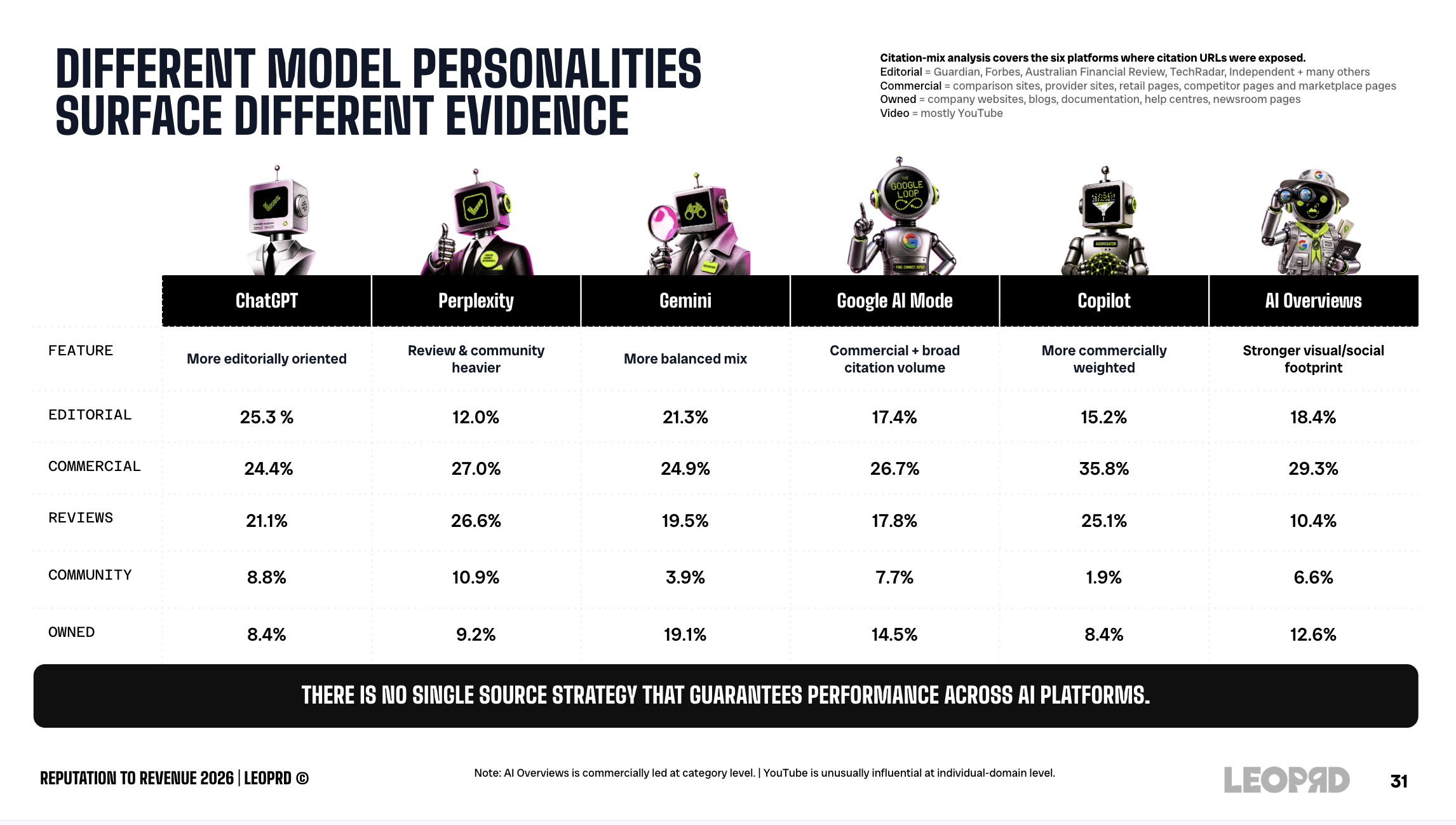
Across the study, 86% of citations came from outside brands’ own properties: editorial coverage, reviews, communities, comparison sites, research, and institutional sources. Your website can define who you are and what you want to be known for, but it cannot single-handedly make that reputation true.
LLMs have access to a much messier public record: your marketing, yes, but also what journalists write, what customers complain about, what Reddit says, what reviewers notice, and, in addition, what your competitors say about you.
Which means marketers need to stop treating AI optimisation as a content-production exercise. The job is to create clarity and corroboration.
Be specific about what you want to own. Stop filling websites with interchangeable marketing jargon. Build distinctive claims around genuine customer needs. Make the proof easy to find, then look beyond your own channels and ask whether the wider information ecosystem tells the same story.
Not forgetting that if the underlying product or customer experience doesn’t support the claim, no amount of schema is going to rescue it.
To date, people have spent a lot of time asking how to make brands readable by machines, but the bigger opportunity is to make them understandable, distinguishable, and recommendable.
Language gives AI a reason to know what you do and why; then the evidence gives it a reason to endorse you.

Celia Harding is the Founder of LEOPRD, which helps brands understand and influence how they show up in AI, unlocking commercial growth. To read the Reputation to Revenue Report, visit report.leoprd.io. Celia will be presenting the findings at humAIn on 13 October 2026.