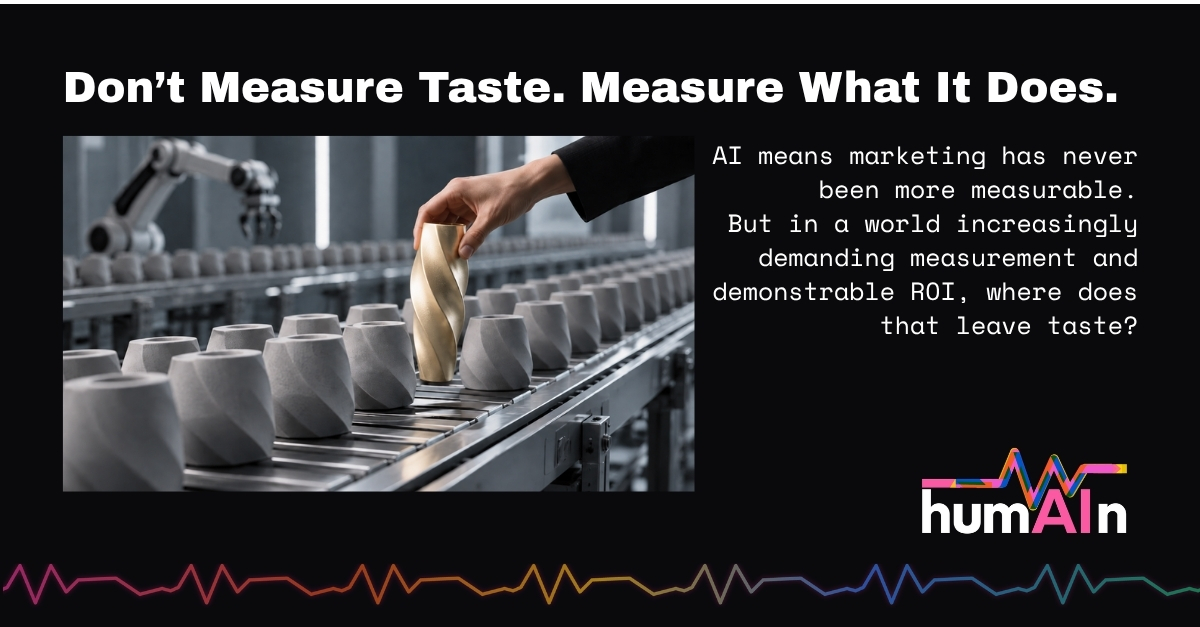
AI means marketing has never been more measurable. But in a world increasingly demanding measurement and demonstrable ROI, where does that leave taste?
AI has made marketing more measurable than ever before.
Attribution, incrementality, and marketing mix modelling that used to be the domain of specialists and data scientists are now available to almost any marketing team.
In parallel, these tools have reinforced the language of demonstrable return in boardrooms, and as marketers, we have to be able to speak to the incrementality of our investments.
Overall, this has been good for us. A lot of spend that was assumed to be efficient is being challenged, and we can now have sophisticated conversations about brand investment on a level playing field.
But it also raises a question: if everything has to prove a return, where does that leave the parts of marketing that resist a number? Creativity and taste, the judgement to identify what is distinctive, culturally and aesthetically relevant, have always been measured by softer metrics.
When hard MROI is the language of CFOs and the pressure for marketing efficiency arrives, ideas that live outside tried-and-tested media are the easiest to cut. AI is doing two things at once. It is making things easier to measure and increasing the demand for ROI. It is also making decent creative very low cost. But with more people using the same tools, output will quickly start to average out and look the same, which will undermine the very incrementality we need to achieve.
The antidote to that is taste: distinctiveness and originality, the ability to sense what the market wants or where it is heading, knowing what is worth making. These are qualities that tap into the essence of being human.
Good taste and discernment will dramatically increase in value. We can't prove the ROI of an idea before it launches, but a strong enough track record can establish a pattern of being right.
It's tempting to resent the obsession with commercial results, to think that some things simply cannot be measured in ROI terms. But that's not the world we're living in. Creative diagnostics via self-reported surveys, earned media via coverage, experiential via URL page views: these don't always hold up in conversations about ROAS and CAC. The problem is amplified when we try to fund cultural-led ideas that are often more expensive and complex to execute than standard advertising.
Can we prove that the additional creative ambition actually produces greater commercial value?
What if we could measure taste the way the boardroom expects: not by asking people what they thought of an ad, but by measuring behaviour? Strong creative ideas hold attention, earn search, get shared and drive more visitation and more revenue from the same media budget. These are measurable behaviours that should be connectable to an incremental outcome, the way the rest of marketing already is.
This is a difficult problem, but one worth solving.
As a starting framework: did the idea stop someone in their tracks? Did that attention change behaviour? And did that shift ultimately produce a flywheel effect on media effectiveness that led to greater incremental value than the benchmark?
If we can talk about the creative and cultural side of our work in the language the boardroom already uses, we secure a credible seat at the table and the support to do the kind of creative work every marketer wants to do. AI is going to make taste the thing that sets brands apart. Proving its worth is one of the most valuable measurement problems left to solve.