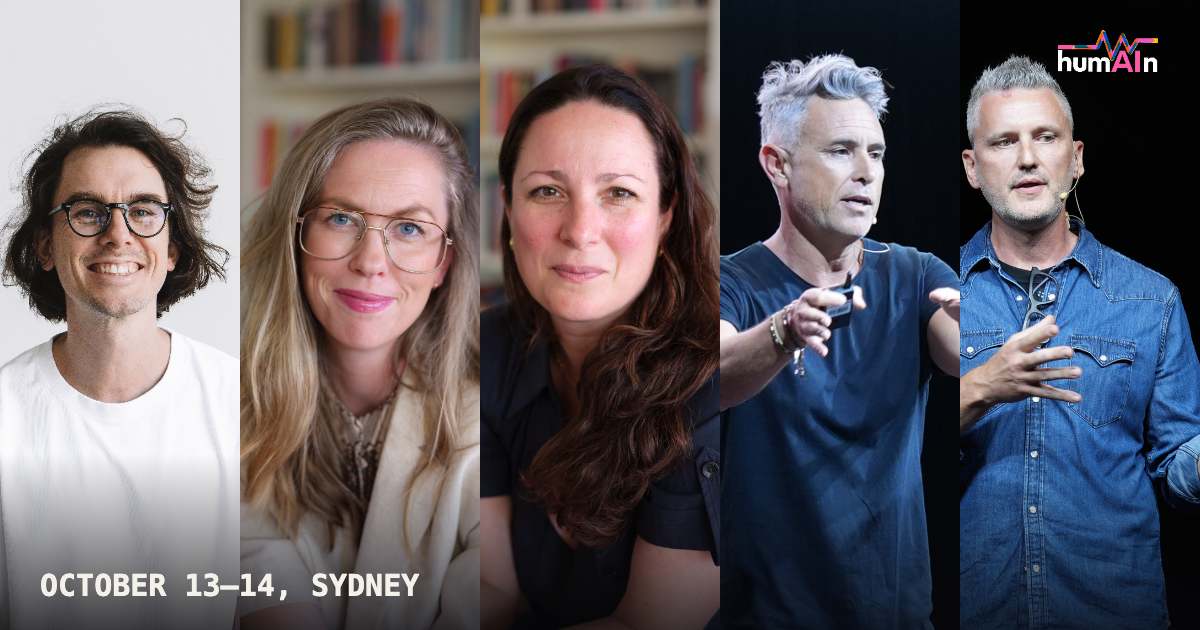
humAIn 2026 announces first sessions: a BytePlus keynote, three practitioners go head to head about what AI is doing to creative work, and Chatham House Rule roundtables
humAIn, the independent AI conference for Australia's marketing, media and creative industries, has revealed the first sessions of its 2026 programme, ahead of the two-day event in Sydney on 13 and 14 October.
The programme includes a keynote from BytePlus, ByteDance's enterprise technology arm, and centres on a three-way session that puts Australia's first AI film studio, the judges of a global AI awards programme, and a founder building his own creative AI model on the same stage, then lets them go head to head.
Keynote: Scale, Speed, and Soul: AI Infrastructure for Human-Centred Experiences - James Caldwell, BytePlus
BytePlus is one of the few companies building both engines of the modern creative economy: content production, and the algorithm that decides what gets seen. Caldwell will draw on ByteDance's data to show how the feed rewards human engagement and authentic work over volume and AI filler, arguing that scale and speed are now table stakes, and judgment, taste and soul are the competitive edge.
Main stage: When Everyone Can Make Anything, Why Does Everything Look the Same?
Three practitioners, three bets on what AI does to creative work, followed by a robust discussion.
The promise. Kent Boswell & Marcus Tesoriero run AiCandy, Australia's first AI film studio, where every pixel of their work for the United Nations and Four Seasons was generated rather than filmed. A year into running it commercially, they make the case for amplification: AI removes the budget ceiling and lets any brand make the impossible.
The field report. Marie-Céline Merret Wirström & Vinne Schifferstein Vidal of MC&V judged more than 1,000 entries from 45 countries for the AARON Awards. Their verdict pushes against the full-stack AI creative thesis and demonstrates the best work came from judgment, craft and collaboration.
The machine operator. Pip Bingemann founded Springboards.ai, and is building a model for divergent thinking. His argument is that AI's real risk is seduction rather than fraud. Fluency fools smart people, and tools sold as productivity are quietly engineering distinctiveness out of the work. He calls it a sameness crisis hiding inside the productivity boom.
Roundtables
Some conversations are too important - and too nuanced - to fit into a keynote.
During lunch, humAIn delegates can join one of a series of facilitated round tables operating under the Chatham House Rule, creating a space for frank discussion of the urgent questions the industry is still working through. Each table explores a different challenge, from AI governance and copyright to bias, sustainability and consumer trust.
The round table topics include:
- Bias, Representation & Fairness. How do we identify and reduce bias in AI systems, creative work and marketing decisions? What does responsible AI look like in practice?
- Copyright, Provenance & Creative Ownership. Who owns AI-assisted work? How do brands manage copyright risk? How should we build AI sovereignty in Australia? Will provenance become a competitive advantage as synthetic content becomes ubiquitous?
- Privacy, Governance & Consumer Trust. How should organisations balance innovation with compliance? What governance frameworks are actually working, and how do brands maintain trust in an AI-mediated world?
- The Environmental Cost of AI. AI's hidden footprint, Scope 3 reporting, procurement, energy consumption and what sustainable AI adoption means for marketers and business leaders.
- The Future of Work. How are roles changing? Which skills become more valuable? How do organisations build capability, preserve expertise and create meaningful careers in an AI-first workplace?
humAIn curator Cat McGinn said "Every one of these speakers has staked a business on their answer to the same question, and they don't agree. That's key to what we’re building at humAIn. Not a panel where everyone nods, but people with skin in the game who bring insight and dissent to this evolving conversation.”
humAIn runs 13 and 14 October in Sydney, with a conference day followed by a workshop day. Roundtable seats are limited.
Early bird tickets close 25 August, and further speakers will be announced over the coming weeks.