For decades, marketers have learnt to obsess over the economics of attention.
CPM. CPC. CTR. CPA. ROAS. LTV.
We can tell you what it costs to reach someone, acquire them and, increasingly, retain them.
We analyse media plans to decimal places. We optimise audiences, placements and creative, trying to squeeze increasingly more from every dollar.
As we should.
But there's a new cost insidiously making its way into the marketing P&L, with little to no oversight and a lot of misunderstanding.
The Cost of Intelligence
McKinsey has recently been doing a lot of work around the economics of agentic AI and what it calls the "cost of intelligence". Its research found 93 per cent of respondents were exceeding their AI budgets.
What fascinates me is what happens when we take that problem out of the technology department and put it inside marketing.
Because McKinsey also estimates agentic AI could eventually power around two-thirds of current marketing activities.
Now we have a very different commercial question on our hands.
As AI moves from something marketers occasionally prompt to a fully integrated supporting operational layer for marketing, the economics change…dramatically.
Every audience analysed, brief written, creative variation generated, campaign optimised and customer journey personalised has a cost.
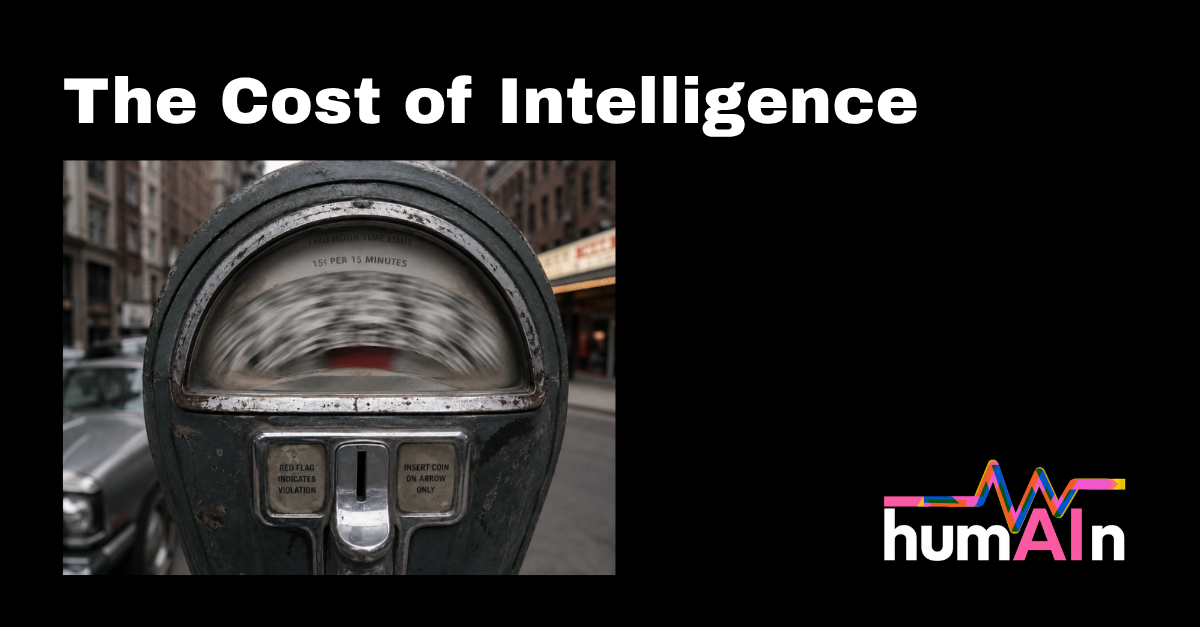
Every action clicks a running meter.
And if AI is going to produce, optimise and automate more of our marketing, CMOs need to know what it is costing and what they're getting back.
We Need to Measure the Work, Not Just the AI
Right now, much of AI economics revolves around tokens, credits and API calls. Useful for billing but pretty useless in a marketing meeting.
Tell me my team consumed 10 million tokens last month and I genuinely don't know whether to congratulate them or shut the system down.
What did those tokens actually DO?
Did we create 1,000 campaign assets that made it into market and sold something?
Did we eliminate 500 hours of repetitive work?
Did we test 50 creative hypotheses instead of five, and was that beneficial?
Did we optimise media to reduce acquisition costs?
Did we get campaigns into market faster?
Did we increase net revenue?
To be crystal clear: 'Tokens' are the cost. They're not the result.
We've been through this before in media.
An impression isn't an outcome. A click isn't a customer. Reach without relevance isn't automatically valuable.
Metrics only become meaningful when we understand what happened because of them and the commercial results they produce, often in combinations rather than in isolation.
AI needs the same rigorous discipline.
Marketing Needs Its Own AI Work Units
It needs to connect the cost of intelligence to a useful unit of completed work and, ultimately, the commercial value it 'created'.
In creative design, that might be total cost per approved asset, which would necessarily include all rejected variations.
In media, we could consider the cost per optimisation versus the incremental performance improvement it created.
In the customer experience journey, it could be aggregated to the cost per successful purchase.
In marketing operations, we could track the cost per workflow versus human labour hours, agency fees, delays and errors it reduced.
We will eventually determine the new acronyms for these new metrics, but the more existential question remains:
What is the best combination of human expertise, AI models, agents and technology to produce the optimal result?
Notice I used optimal, not cheapest.
Because this isn't a race to remove humans or slash costs.
It's about deploying intelligence where it creates the best, strategically commercial outcomes.
This Changes How We Need to Think About Marketing
The amazing thing about AI is that it's not just about the deliverables it creates.
The real opportunity is in understanding what, why and how it can be moulded to optimise outcomes based on context, budget and strategic versus tactical determinants.
This is the new marketing frontier.
We've spent decades trying to eliminate wasted media.
Now we need to think just as seriously about wasted intelligence.
Uninformed CMOs could build incredibly sophisticated systems that produce more assets nobody needs, more reports nobody reads, more personalisation that doesn't change behaviour and optimisations of objectives that don't matter.
In other words:
AI Can Burn Money Faster Than Ever
So, my belief is the winners of this next era won't be the organisations using the most AI.
They'll be the ones who understand where AI creates genuine leverage. They will have to know exactly what that intelligence costs, including the how and why, to confirm to the board that every additional dollar of AI consumption created more net commercial value than it cost.
We know there will be big winners and big losers…
The question remains: which side of that equation will you be on?
Aleisha McCall is a Marketing, Media & AI Transformation Strategist, industry keynote speaker, multi-award winner, and a ten-time recipient of the B&T Women in Media Power List. She is also the host of The Black Box of Media podcast, where she lifts the lid on the hidden strategies behind high-performance media advertising, interviewing marketing leaders, media experts, and brand executives to uncover the tactics that consistently deliver market-beating results.
As Founder & CEO of Ultimate Edge Communications, Aleisha helps organisations redesign their marketing and media advertising operating models for the AI era. Over the past two decades, she has led more than $100 million in marketing investment, generating over $500 million in client revenue and more than 1 million leads. She works with senior executives and their teams to eliminate fragmented marketing practices, integrate AI into commercial operations, and deliver measurable, high-ROI business outcomes.