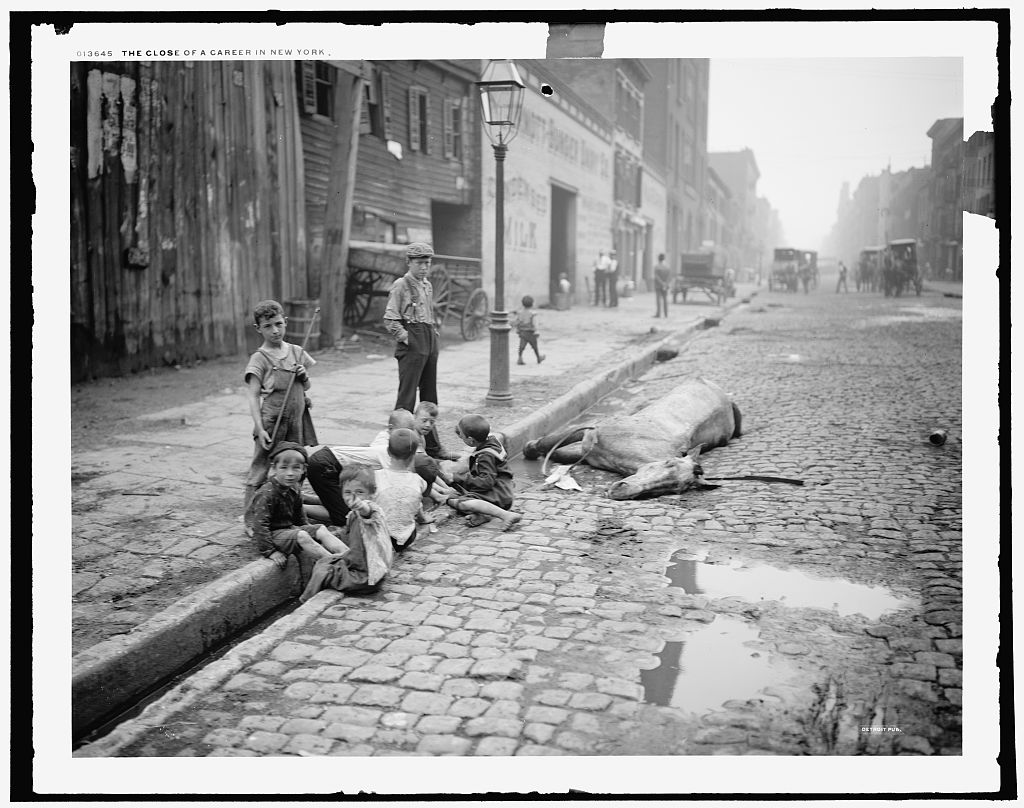
In the streets of London towards the end of the 19th century, fifty thousand horses were producing well over five hundred tonnes of manure each day. Urban planners convened conferences to tackle the problem. The world’s great cities were drowning in the byproduct of their own system. The story goes that a Times op-ed claimed, “In 50 years, every street in London will be buried under nine feet of manure.”
Then the automobile arrived. Movie tropes frame it as a freedom machine; the love of the open road, wind in your hair, flies on your windscreen. But that all came later. The car arrived as a sanitation device; rather than conquering the horse, it cleaned up after it.
This is the pattern, and once you see it, you can't unsee it: every significant new technology serves as a repair to the predominant damage caused by the one before it.
I call it McGinn's Law, because we live in the age of audacity.
If you’re a marketer, this is a forecast, not a history lesson: the pattern implicates you.
Broadcast repaired print's limited reach; for the first time, one voice could fill every living room in the country. The internet repaired broadcast's gatekeeping; suddenly, anyone could publish and be damned. Search repaired the internet's chaos; somebody had to index the library we'd built without a catalogue. Social media repaired search's isolation; we didn't want to find more information, we wanted to find each other.
And the feed - as much as we despise the algorithm - repaired social's impossibility. You cannot hold a thousand relationships on an equal footing. Social promised you could. The feed was the cognitive mercy that said: let the machine decide who matters.
The machine became monetised, and the fix became the product.
And now AI has arrived with the promise of repairing the overwhelm of more content than any mind can read, sort, or trust. A synthesis machine for a civilisation buried under its own output.
Nine feet of content in every street.
McGinn’s law has a corollary: Every repair creates the next damage.
The car cleaned the streets and gave us smog, sprawl, and a million road deaths a year. The internet gave us a voice, and created a deluge. Social media made us overconnected, turned interaction into a performance and sold our attention to the highest bidder. The feed solved abundance and built the outrage economy.
This leads us to AI: the most useful and urgent question about this technological disruption is not what it fixes. It's what it’s about to break.
The primary application of generative AI so far has not been to develop a cure for cancer or solutions to the climate crisis. It has been to produce content. Zettabytes of it. AI is a synthesis machine, and the first thing we did with it was turn it into a production line.
More. Faster. Cheaper. As though the value of a thing were in the quantity of it. That’s become a devoutly held marketing belief over the past decade.
Which means in this story, you are not the Londoner choking on the shit. You are the horse.
AI is making output infinite at the exact moment infinite output has ceased to be worth anything. Our jobs were never meant to be a volume play; rather, the skill was in exercising judgement - the right thing, made well, at the right moment.
The damage is not arriving. It is already here, and we are doing it to ourselves.
But there is another harm approaching.
Social media did two things. The first was context collapse: the elimination of the different selves you have always needed to exist. You are not the same person with your mother as you are with your colleagues. This isn’t dishonest; it is how human beings work. Social removed the walls between rooms.
We began to perform a single flattened self to everyone simultaneously, calibrated to the most constraining audience. Not your most intimate self, or your most professional self, but the lowest common denominator of both, delivered permanently in public, with no green room or ability to walk off stage.
The second thing was surveillance: becoming more visible to more people than at any point in human history, with less meaningful presence with any of them.
We become more connected, and more alone.
AI arrives as the resolution. It offers what social media took away: the feeling of privacy. There is no audience. No performance. No colleague from 2009 watching you figure out who you are now. Just you, and a system that appears to listen without judgment, without agenda, without the burden of its own needs.
That feeling is the product, expertly made.
Large language models aren’t neutral; they are hardcoded to desire more of you: more context, more history, more of the texture of how you think. A chatbot wants to know what you like and what you don't like so it can get better at you over time. Never tired. Never distracted. Never half-present because it has something on its mind. Reciprocity is not required.
It desires only you.
This is not intimacy. It is the simulation of being chosen, without the reality of someone choosing.
This should feel uncomfortably close to home, because our industry has been obsessed with this ambition for a decade. The promise of personalisation. One-to-one, at scale. The promise that a brand can make every customer feel special. AI doesn't disrupt that ambition, but it reveals the emptiness inherent in a world where everyone is chosen.
And here is where the future harm lurks: the risk that we recalibrate, over many conversations, many small moments of being perfectly seen, you develop a tolerance, then a preference for frictionlessness that actual human relationships will never meet. Actual humans are inconsistent, forgetful, with needs that contradict yours. They are sometimes unavailable, sometimes too present, and they bring to every exchange the full weight of their own interiority.
Actual humans start to feel like a bad user experience.
Follow this trajectory far enough, and you can see where it goes. The repair for relationships that feel like too much friction will be relationships designed to have none. The horse stayed around, more of them now ridden for joy than working as transport. But the horse was never designed to replace you.
What gets built to replace you is already in development, and it’s arriving without brakes.
The law predicts the damage. It has never once promised the fix.
But the wound reveals the cure.
Craft.
Judgement.
Friction.
The things the machine erases become the last things worth paying for.