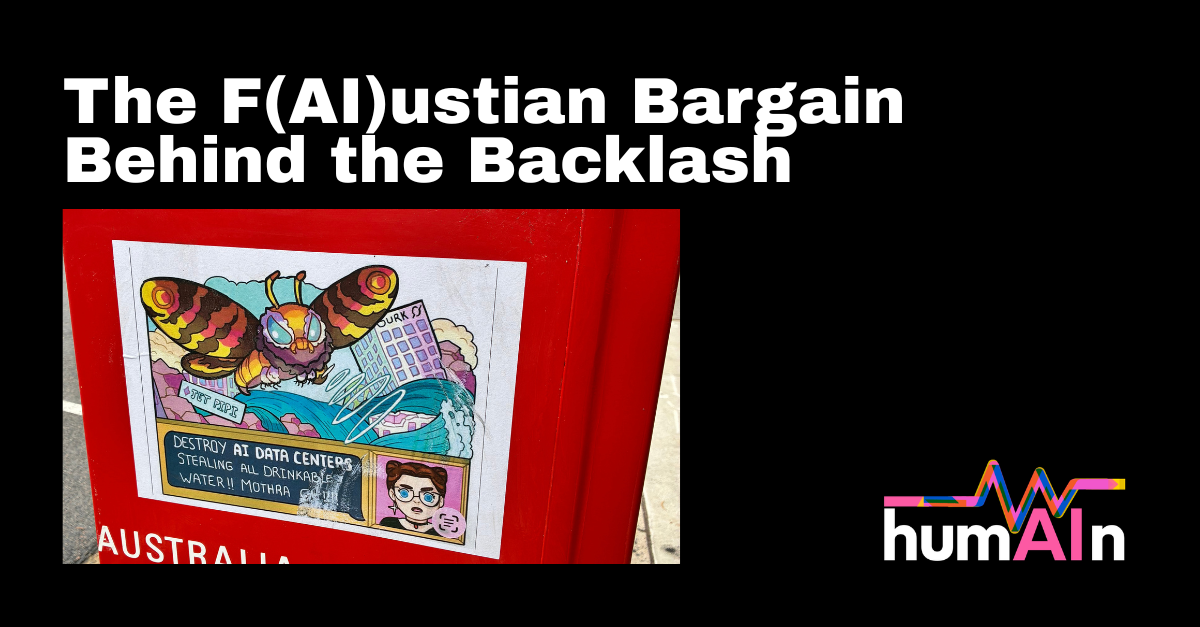
Earlier this week, walking through the unprepossessing streets of Gosford on the NSW Central Coast, I came across a beautifully illustrated poster protesting against AI data centres.
Gosford is a place where the local economy has been crumbling for generations. And yet somebody had invested in making this thing. They had drawn it, printed it, and carefully glued copies around the town centre.
A few days earlier, in a pub in Sydney, I had seen the less nuanced version scrawled on a cubicle wall:
FUCK AI.
These moments aren’t outliers. The internet is thick with the same sentiment, expressed with varying degrees of wit. Polaroid has built a global campaign on it: put the phone down, go touch grass, shoot on film, with a dig at AI data centres for good measure. When a camera company builds a campaign on anti-AI feeling, it stops being a fringe position and starts being a safe bet.
Australia now ranks equal lowest of 23 countries in EY’s global AI sentiment study, with a score of 52 against a global average of 66, despite 77 per cent of Australians saying they use AI. The Office of the Australian Information Commissioner has also found that just 4 per cent of Australians trust AI companies with their personal information.
This is not a reactionary population refusing to engage with an unfamiliar technology. Australians are famously early adopters; in 2011, Australia had the second-highest smartphone penetration in the world. But in 2026, Aussies are using genAI in record numbers, while becoming deeply suspicious of the people and institutions deploying it.
I have written that AI has become a kind of cultural shorthand for the ruptured trust and general disaffection many people feel towards institutions and systems of power. We ignore that at our peril.
Because the backlash is not singular.
It is about data centres and the resources required to sustain them.
It is about human knowledge, culture, creative work and personal data being used to train the systems.
It is about predictions of job losses and decisions increasingly being mediated by systems people neither understand nor control.
And yes, it is also about the insultingly poor quality of AI slop.
These are different objections, but underneath beats the same question:
What exactly are we getting in return?
Because sometimes the exchange feels less like an invitation to participate in an extraordinary technological transformation, and more like:
Eat up, piggy.
Here is your synthetic article.
Here is your AI customer service.
Here are 300 personalised variations of the same ad.
We could have paid an illustrator, but this will do. We could have questioned whether this was beautiful, useful or interesting, but this will do.
Here is a flood of content nobody asked for, created because it was cheap. That’ll do, pig.
What AI slop symbolises is not simply bad taste. It is a lack of regard.
AI has made the production of content astonishingly cheap. What it has not made cheap is care, and people can tell the difference.
David Ogilvy’s famous admonition that “the consumer isn’t a moron; she is your wife” was about respect. Somewhere along the way, we seem to have forgotten that.
The backlash was visible at American graduation ceremonies this year, where students at several universities booed speakers extolling the possibilities of AI. Former Google CEO Eric Schmidt was repeatedly jeered while addressing University of Arizona graduates. AI is becoming entangled with a much wider distrust of corporations, institutions and the future being offered to people.
Even those building the technology acknowledge the problem. Anthropic CEO Dario Amodei recently described it as “fundamentally a crisis of trust”, and conceded that AI companies “haven’t yet delivered on our big promises to benefit the world.”
His prescription was simple: stop telling people AI will cure cancer. Actually cure cancer.
A strong start...
I have been called “AI’s most anguished champion”, which remains irritatingly accurate. I use these tools constantly. I have seen uses of AI which democratise expertise, reduce accessibility barriers, remove pointless work and allow people to build things previously beyond their reach.
But optimism does not require acquiescence.
The backlash is not a referendum on AI adoption itself, but rather a referendum on the bargain being offered around it.
If we dismiss opposition to data centres as NIMBYism, artists’ concerns as protectionism, graduates’ anxiety as resistance to change, and public distrust as ignorance, we learn nothing, and we squander the opportunity to course correct.
We’re not faced with a decision as to whether AI will advance. It will.
The decisions we need to make are about what we want to advance towards, who gets to decide, and whether the people on the receiving end feel they are participants in that future, or merely consumers expected to swallow whatever they're given.
That little poster in Gosford was not a rejection of the future; it was a protest against loss of agency.
Whatever you may think about their argument, you cannot fault the care. And amidst a background of outdoor ads and graffiti, traffic and noise, that cut through.
For marketers, this is the most hazardous trend of 2026. We’ve spent decades building brand trust, and yet reaching for the cheapest tool in the stack is also the fastest way to erode it.
The winning brands of the next decade won't be the ones who use AI the most, but the ones who use AI with the most discernment, transparency - and care.