For years, when people described my career as a “portfolio career”, I suspected what they actually meant was undiagnosed ADHD.
I have moved between media, advertising, marketing, events, strategy, writing, teaching and various other things that become increasingly difficult to explain at parties. Some of this was deliberate: I wanted to understand how all the pieces of the media and marketing ecosystem fitted together.
Some was less strategic. I get bored.
Specifically, I get bored when I have worked out how to do something and the job becomes doing essentially the same thing again, incrementally better.
My dad's career could hardly have been more different. He graduated as an architect, joined a firm and stayed there for his entire working life, eventually retiring as its senior partner.
For his generation, that represented an extremely successful career. But as we reckon with the profound disruption of our working lives, I've been wondering whether the career he had - one profession, one organisation, one long climb through its hierarchy - might eventually look like an outlier. Because for much of human history, work wasn't organised into the neat containers we now call jobs.
People specialised, certainly. Blacksmiths and bakers are hardly inventions of the Industrial Revolution. But the household was also an economic unit. People grew food and tended animals, made and repaired things, cooked and cared, traded and bartered. Work, domestic life and production bled into one another.
Industrialisation pulled those things apart. Production moved from the household to the workplace. The twentieth-century corporation then gave us the career ladder. Somewhere along the way we began to attach an extraordinary amount of self-worth to precisely where on that ladder we happened to be standing.
One of the first questions we still ask a stranger is: what do you do?
I keep hearing that resilience and adaptability will be among the defining skills of the AI economy. While that may be true, it ignores the broken bargain underneath.
AI didn't create freelance insecurity, shrinking creative budgets, short-term contracts or the fractional C-suite; the technology is not the architect of these problems but an accelerant.
There is an appealing version of the future in which AI allows more of us to become tiny organisations of one: advise here, lead there, write something, build something, take a fractional role somewhere else. AI handles enough of the research, administration and operational sludge to make the whole operation viable.
For someone like me, that’s exhilarating. But we shouldn’t mistake personal fit for economic progress.
I have decades of accumulated experience, relationships and expertise. I learned on somebody else's payroll. I had junior jobs. People paid me while I made mistakes, watched over the shoulders of people who were better than me, and gradually acquired judgement.
That wasn’t corporate altruism; it was an exchange. In return for that training, institutions extracted decades of our prime creative labour, unpaid late nights, and compound commercial value. The unwritten deal of the corporate ladder was deferred security: you gave the institution your dedication and shouldered its immediate pressures, and in exchange, it sheltered your learning curve, absorbed risk, and rewarded your tenure as you became more senior.
Today, that agreement has been eroded at both ends.
The portfolio career looks different when you have no runway, few contacts and the rent is due. One person's portfolio career is another person's three jobs.
And resilience is a complicated virtue when what we're really describing is an individual's capacity to absorb risk that was once carried by an institution. At what point does telling people to become more resilient feel like gaslighting them into excusing the conditions they're being asked to survive?
The squeeze is across generations. The IAB Australia 2026 Talent Review showed entry-level roles accounted for exactly 1% of all vacancies. At the opposite end, tenured leadership is systematically disassembled into fractional roles, turning career-long institutional contribution into disposable vendor contracts.
AI makes my strange, varied working life more sustainable. It also threatens some of the junior work, institutional structures and creative livelihoods through which people acquired the human capital that makes this kind of independence possible in the first place.
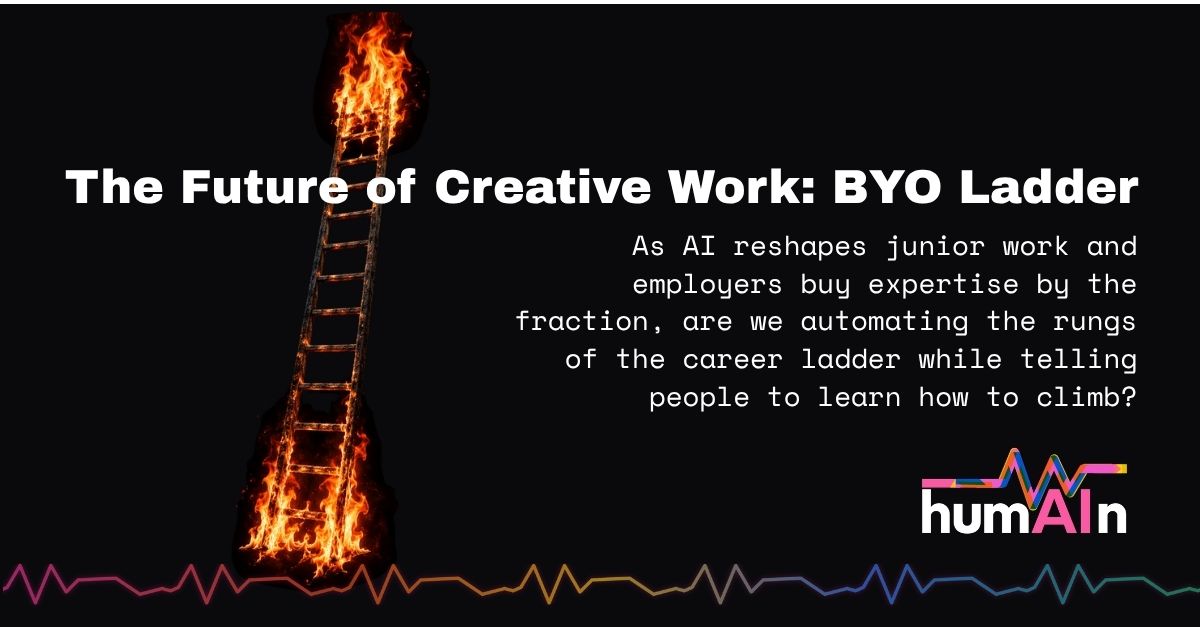
We are automating the rungs of the ladder and then telling people they need to learn how to climb.
Perhaps portfolio careers return us to a working life made up of many different kinds of contribution rather than one neatly bounded job. But a job isn’t only an identity. It’s also infrastructure: income, sick leave, colleagues, training, belonging and shared risk.
The challenge we face now isn't simply to become more adaptable. It is to decide which parts of the old bargain we want to keep. Not a sentimental defense of twentieth-century corporate life; instead designing institutional architecture that pools risk across fragmented work.
The precedents already exist: reinvesting savings in training schemes; portable benefits. When industry leaders announce that employers, universities, and individuals "all have a role to play," they often leave out the client and the structural mechanisms required to fund the future of the craft.
Robert Heinlein had a broader conception of a useful human being. In science fiction classic Time Enough for Love, he produced his famous list of things a person should be capable of doing: changing a nappy, programming a computer, cooking a meal, setting a bone, comforting the dying…
“Specialization is for insects.”
Loosening our attachment to the idea that a title is a meaningful measure of merit, and a shift towards valuing the contribution we make, not external status is a lovely idea. But the flip side is the systematic transfer of commercial risk and operational overhead from the balance sheet of the corporation onto the kitchen table.
When the entry-level rungs are cut away and senior roles are liquidated into fractional contracts, it’s less workforce liberation and more economic precarity, rebranded as "entrepreneurial freedom."
Heinlein’s ideal is the stuff of speculative fiction, not economic reality in 2026. Having to be your own accountant, marketer, vendor, and safety net isn't insect-defying polymathy, it’s an institution walking away from the bill. The portfolio career is wonderful only when backed by decades of security and choice.
When it’s not optional, it’s a broken bargain.