Who gets to decide the future of creativity? It's time for creatives to have their say.
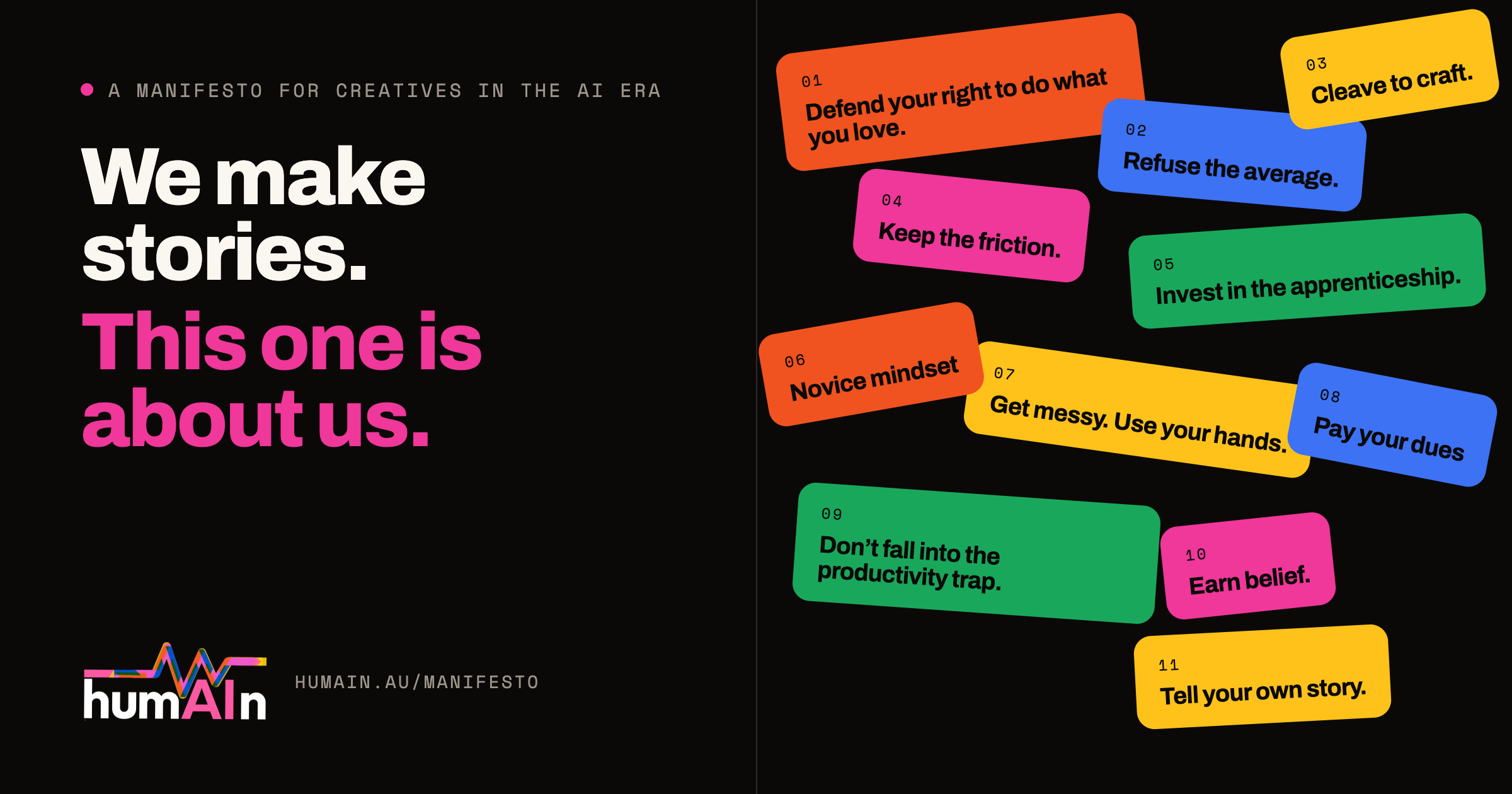
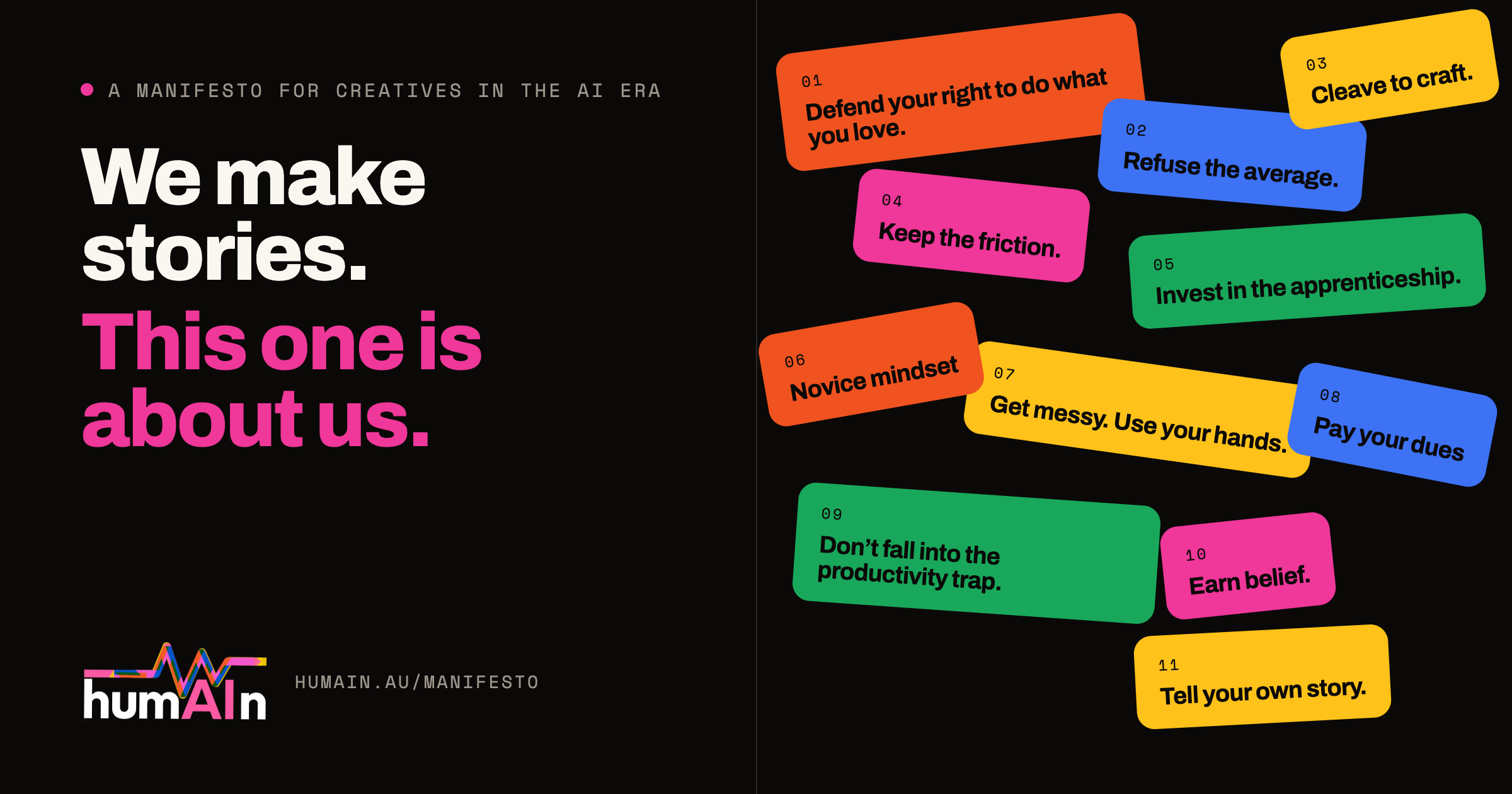
Eleven principles. An unfinished manifesto. An open invitation to Australia's creative industries to challenge, contradict and shape what comes next.
As artificial intelligence reshapes the creative industries at breakneck speed, we're spending an extraordinary amount of time talking about what technology can do, and remarkably little asking what we actually want it to do.
What should we embrace? What should we protect? What are we prepared to lose? And what do we refuse to surrender?
At humAIn, we think it's time the people who tell stories and make things had a greater say in their own future.
We're inviting creatives to co-create A manifesto for creatives in the AI era, opening it to public challenge, contribution and debate.
Eleven principles, developed during #humAIn2026 in October, set out some of the things we believe are worth defending, questioning and reimagining as AI transforms creative work.
But this isn't a finished declaration. It's a starting point. And we're not asking you to agree with us.
Agree. Disagree. Contradict us. Tell us what we've missed.
Beyond what AI can do: what do we want?
The manifesto lands in the same week as the ARIA Awards, where AI was a recurring theme on stage, and more than 30 creative and media organisations launched Not AI's to Take, calling for permission and payment when AI companies use Australian creative work.
It's an important intervention. Our eighth principle, "Pay and credit the people who make the work possible", makes a similar demand for consent, recognition, and compensation.
But the questions facing the creative industries go further than copyright and compensation.
What happens when good enough becomes the default? What do we lose when we eliminate the friction from the creative process? How will the next generation develop their skills if the entry-level work that teaches them disappears? And when AI promises to save us time, who actually gets the benefit?
Among our eleven principles are "Refuse the average", "Keep the friction", "Invest in the apprenticeship", and "Don't fall into the productivity trap".
They aren't commandments. They're provocations, intended to open up conversations we believe the creative industries urgently need to have.
As Matt Jones, founder of ThinkStoryExperience, puts it in the manifesto:
"We can't demand experienced people while removing the experiences that develop them."
Neither anti-AI nor AI-pilled.
Much of the conversation around AI is framed as a question of inevitability: the technology is coming, the industry must adapt, and the only real choice is how quickly we embrace it.
But inevitable according to whom? Who gets to decide what progress looks like?
This isn't an anti-AI manifesto, nor is it AI-pilled. It's certainly not a nostalgic defence of a creative industry that was far from perfect before generative AI came along. There is extraordinary potential here, alongside very real threats. We want the unbridled joy, the rational fear, the uncomfortable truths, and the outright contradictions.
We want to hear about those possibilities, too.
We want the unvarnished version. The unfettered joy, the rational fear, the uncomfortable truths and the outright contradictions.
No sanitised corporate optimism. No obligatory AI enthusiasm. No requirement to agree with us.
What have you made with AI that you couldn't have made before? What excites you? What frightens or infuriates you? Where has it expanded your creative possibilities, and where has it diminished them? What do you refuse to give up?
And what are we getting wrong?
The manifesto has already attracted critics. humAIn founder Cat McGinn's eight-year-old used it to call her a hypocrite, which is exactly the point.
humAIn has a proud history of consultation and guidance, with a set of 20 community-created guidelines for responsible AI adoption in marketing, media, and creative industries, "the humAIn Principles" developed through workshops run by Time Under Tension at the humAIn conferences in 2024 and 2025.
Co-written with creatives. Open to everyone.
Many of the principles draw on conversations from humAIn 2026, held in Sydney on 13 and 14 October, and include contributions from some of the industry's leading creative thinkers and practitioners.
They include Saatchi & Saatchi Chief Creative Officer and AWARD chair Mandie van der Merwe; Leo Australia Executive Creative Director Hilary Badger; Photoplay Executive Producer Ross Colebatch; We The People creative Rhys Delios Callanan; brainstrust founder Ben Cooper; Uber's head of international marketing Lucinda Barlow; CMO and AI advisor Tea Uglow; and ThinkStoryExperience founder Matt Jones.
But the future of creativity cannot be determined by a handful of industry leaders, any more than it should be determined exclusively by technology companies, executives or algorithms.
It needs the people doing the work. The emerging creatives finding their feet. The experienced practitioners watching their craft change. The artists experimenting at the edges. The sceptics, the enthusiasts, the pragmatists, and the people who are still making up their minds.
That's why we've made the manifesto open to industry feedback and challenge.
You can respond to any of the eleven principles, dispute them, share your experiences, suggest what's missing, propose a new principle, and add your signature if you choose.
You don't have to sign to contribute. And you certainly don't have to agree.
Because the future of creativity shouldn't be something that happens to us.
It should be something we decide.
The manifesto isn't finished. Co-create it with us.
Read the eleven principles. Challenge them. Add your voice. Help shape what comes next.