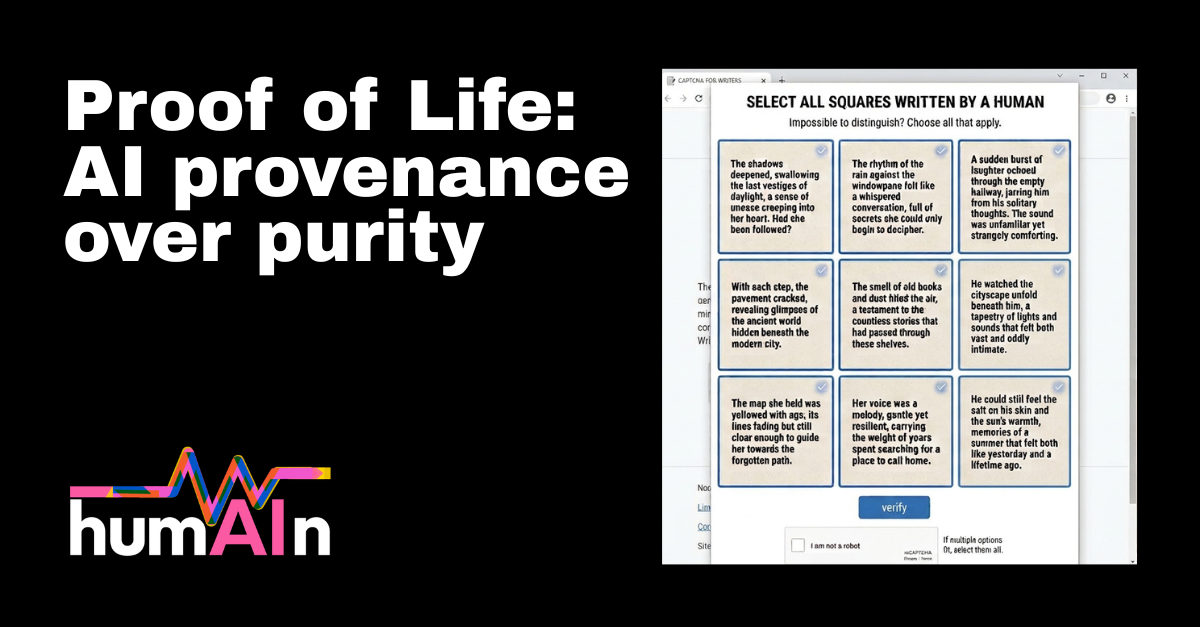
AI detection is becoming infrastructure. A button on LinkedIn, a scan on Substack, a watermark in Claude itself. The legal trajectory is moving toward provenance, while platforms aim for purity, but neither tells us if the work is any good
I made a spelling mistake in an email the other day. The recipient accused me, jokingly, of deliberately planting it so people wouldn’t think I’d used AI.
Proof of life.
I wish I’d been that clever. The logic is pretzel-like: polished writing is evidence of AI, but imperfection is evidence you’re gaming the system. That torsion is emblematic of the way we’re twisting in the wind while we figure out how to adapt to AI and value what’s human.
We’re entering the witch-hunt era. Em-dashes, certain phrases, suspiciously competent prose without an actual point of view attached: we’re delighted when we spot the ‘tells’ and the test has now become unfalsifiable: anything too human must be a more sophisticated deception.
The suspicion became infrastructure recently. Linkedin’s “seems like AI slop” button takes our reasonable unease and turns it into a hammer; a little on the nose for a platform that encouraged us to re-write our thoughts with AI in 2023.
On a platform engineered for reach, reputation and network building, the stakes are high, but the adversarial issue seems unchecked. What stops competitors reporting their rivals, disgruntled employees reporting employers, co-ordinated pile-ons? We learnt in the late teens what happens when social platforms turn subjective judgement into a weapon at scale.
“Seems like AI Slop” isn’t a statement of fact, or evidence of harm, it’s a vibe check, but the mechanic or consequence is undisclosed.
Substack’s decision to implement AI detection software Pangram on its platform moves past accusations to detection, but it’s a flawed approach. Using ‘good’ AI to stop ‘bad’ AI is at best, simplistic, and at worst, side-steps the issue entirely.
Detection can tell us something about machine involvement. It cannot tell us who had the idea, who exercised judgement, whether the work is original, whether it is true, or whether it is any good.
Anthropic’s watermarking announcement this week has moved the responsibility upstream; establishing provenance at the point of creation. The direction of travel is moving from the platform to the source, a move framed as compliance with Article 50 of the EU AI Act.
The act requires synthetic content - audio, image, video and text - to be marked and machine-readable. California's SB 942 requires providers to embed provenance information and provide a free public detection tool, with penalties of up to $5,000 per day for violations, although as yet this doesn’t cover text. New York’s synthetic performer laws came into effect in June. If a synthetic human appears in advertising material, the use of AI must be conspicuously disclosed.
Marketers aren’t spectators in this arena; tasked with creating industrial volumes of content, public by design, with greater visibility and risk, the stakes are high.
We don't yet have an equivalent economy-wide legislative regime in Australia, and the mandatory guardrails for high-risk AI have been shelved. But the National AI Centre's essential practices already ask organisations to be clear about AI use, and the Australian Signals Directorate has published guidance on Content Credentials. Guidance and government technical standards are pointing toward disclosure, watermarking, metadata and provenance.
It would be a bold CMO or agency boss who assumes Australia will remain an exception to the provenance move.
Like so much of the AI disruption, it’s riddled with paradox and complexity. While regulators are building frameworks about who and what must be disclosed, platforms are informally building a system based on who looks guilty.
One approach says ‘disclose’, the other says, 'I’ve eyeballed it and I think it's AI.” One approach builds accountability, the other creates suspicion.
Provenance isn’t prohibition.
The core issue is that audiences, customers, voters, feel uneasy when there is a lack of transparency, because knowing what’s real is a deep human need. The goal isn’t to stuff the genie back in the bottle, it’s to give people confidence that they know what they’re looking at.
It’s a false binary. My process for several years now has been to dictate ideas into a chatbot, ask it to restructure my notes, push for greater clarity, spot logical fallacies and check facts. I then rewrite that outline, and use AI to edit. So who wrote this, me or Claude?
It’s the wrong question. AI has become synonymous with “slop,” but people have been producing staggering quantities of utter garbage for aeons without machine assistance.
Thirty years ago, my dad recorded devastatingly precise letters into a dictaphone for his secretary to type up, which he’d then proofread and sign. No one suggested he wasn’t the author.
Provenance tells you where something originated. It isn’t a stamp of quality.
A question I think worth exploring is the productivity trap itself. Before we convict people for using AI to generate content, first ask why we’ve decided everyone needs to produce such volumes of it. Everyone on Linkedin needs to be a thought leader. Employees are encouraged to build their personal brands in service of their employer. Marketers are sending forth endless content to feed more channels than ever. We built an attention economy, one which is exhausting to creators and consumers alike, and now we’re punishing people who have chosen to use machines to supply the pap other machines chew through.
As with so much of the AI conversation, the tech didn’t create the problem, merely shines a floodlight onto existing structural issues.
The distinction should not be between AI and human. Right now we’re framing it as a choice between provenance and purity. We need provenance. The notion of purity should fill us with deep unease.
We aren’t returning to a world uncontaminated by AI. We do need to build one in which we can understand how information and content was created, so we can evaluate it accordingly. Is it good? Is it true? Is it useful? Who made it, and why?
I can’t prove to you I wrote this.
But if you think it wasn’t worth reading, that’s not an AI issue.